Where China Surplus Small Appliances Can Grow: Southeast Asia, the Middle East and Africa
2 October 2026
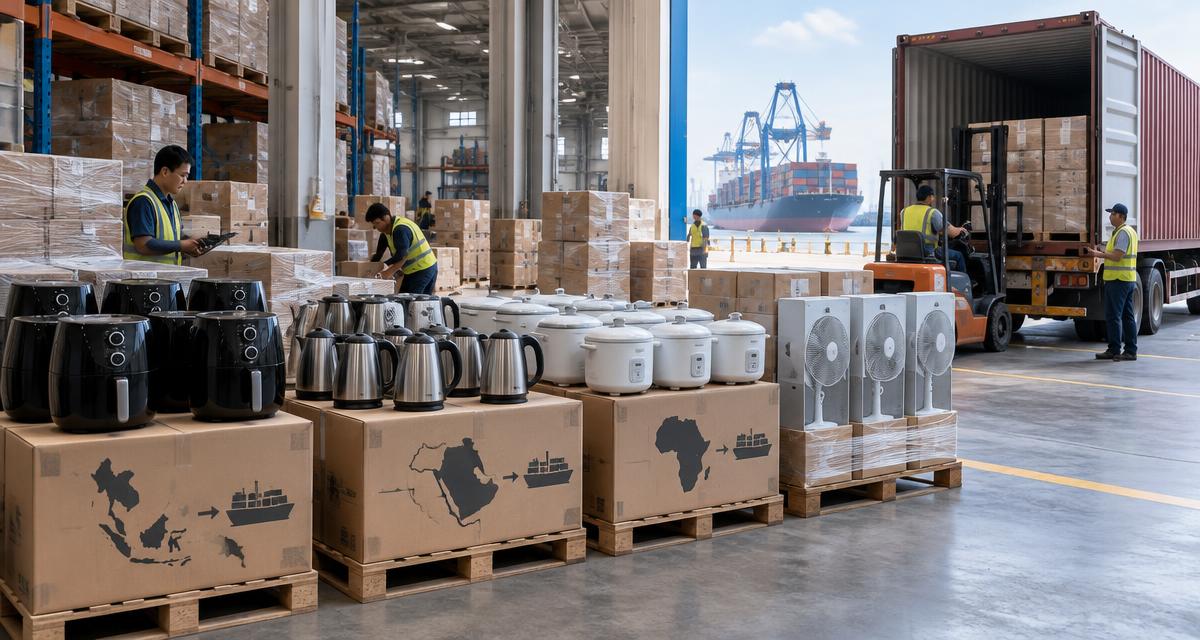
Surplus small appliances from China can create value in Southeast Asia, the Middle East and Africa when the stock is matched to the right market, certification and sales channel. The opportunity is not simply “cheap inventory.” It is the ability to offer useful products at accessible price points, in quantities that let distributors and online sellers test demand without committing to a full production run.
Why these three regions matter
Southeast Asia, the Middle East and Africa are not one market. They contain countries with different income levels, plug standards, certification rules, languages and retail structures. Yet they share several conditions that can favor well-matched surplus lots: expanding urban populations, strong social-commerce activity, demand for practical home upgrades and a wide network of regional importers.
Chinese small kitchen appliances also have an established export base. Public industry reporting citing the China Chamber of Commerce for Import and Export of Machinery and Electronic Products said Chinese small kitchen-appliance exports increased 14.3% year on year in 2023. That broad export capability gives buyers access to mature product categories, supplier depth and frequent model renewal.
Southeast Asia: fast testing through digital commerce
Indonesia, Vietnam, the Philippines, Thailand and Malaysia are important markets to evaluate, but buyers should select products country by country. Compact air fryers, rice cookers, kettles, blenders, fans and personal-care appliances fit common e-commerce and live-commerce formats because their benefits can be demonstrated quickly on video.
Surplus lots can help a distributor test a new capacity, color or feature set before placing a larger OEM order. Smaller mixed orders may also help regional wholesalers serve several cities or online channels. The strongest opportunity usually comes from combining an attractive landed cost with local-language content, reliable after-sales planning and the correct voltage, plug and certification.
Middle East: value, capacity and presentation
The Gulf markets can support demand for air fryers, electric kettles, food-preparation appliances, vacuum cleaners and personal-care products. Importers often need product presentation, Arabic labeling and market-specific conformity work to be resolved before shipment.
The United Arab Emirates can function as both an end market and a regional trading hub. Saudi Arabia offers scale but requires careful attention to current conformity and labeling requirements. Iraq, Jordan and other nearby markets can present distributor-led opportunities, depending on local import rules and payment arrangements.
For surplus stock, packaging condition matters. A competitive price does not compensate for a carton that is unsuitable for a premium retail shelf. Buyers should separate retail-ready stock from carton-damaged or open-box stock and price each grade accordingly.
Africa: distribution-led opportunities across diverse markets
Africa should never be treated as a single destination. South Africa, Egypt, Nigeria, Kenya, Ghana, Tanzania and other markets differ substantially in purchasing power, retail infrastructure, currency risk and product requirements.
Practical categories such as kettles, fans, blenders, hair dryers, rice cookers and compact cooking appliances may fit wholesale and independent retail channels. In some markets, smaller pack sizes and robust mechanical controls can matter more than premium feature lists. Importers should evaluate spare parts, warranty handling and local power conditions before choosing a lot.
The commercial advantage of surplus matching
A normal production order optimizes consistency and customization. A surplus transaction optimizes speed, price and flexibility. That makes it useful for:
- testing an unfamiliar product category with lower inventory exposure
- supplying flash-sale, live-commerce and promotional campaigns
- filling a temporary gap while a regular production order is in progress
- serving price-sensitive wholesale channels with clearly graded stock
- combining several categories into a market-specific buying plan
The trade-off is that quantities, colors and packaging may be fixed. A buyer should therefore receive a clear stock manifest, condition grade, inspection scope and loading plan before confirming an order.
Compliance comes before price
Voltage and frequency, plug type, labeling, product documentation and conformity requirements must be checked for the destination country. Requirements can change, and a certificate accepted in one market may not be sufficient in another. Importers should confirm current rules with qualified local advisers and authorities before shipment.
BulkVolt masks brands and factory identities on public pages. Approved buyers can then review fuller lot information, request inspection evidence and discuss destination-market requirements before a transaction proceeds.
A practical buying checklist
- Define the destination country and sales channel first.
- Confirm voltage, frequency, plug and labeling requirements.
- Ask for quantity by model, color and condition grade.
- Separate factory-sealed, open-box and carton-damaged units.
- Agree on inspection sampling and functional test criteria.
- Calculate landed cost, not only the ex-factory price.
- Plan warranty, returns and spare-parts handling locally.
Frequently asked questions
Which region is the biggest opportunity for Chinese surplus appliances?
There is no universal winner. Southeast Asia can be attractive for digital commerce and rapid product testing; Gulf markets can support higher-value kitchen and home products; African markets can offer distribution-led demand for practical, competitively priced appliances. The best opportunity depends on the exact lot and destination requirements.
Are surplus appliances used products?
Not necessarily. Surplus can include cancelled orders, overproduction, packaging changes, discontinued colors or stock held after a buyer changed plans. Condition must be documented lot by lot.
Can buyers start with a small quantity?
Some lots can be sold by carton or pallet, while others are available only as a complete lot. The available quantity and minimum order should be confirmed before inspection.
Key takeaway
The strongest export opportunity is not created by sending the same stock everywhere. It comes from matching each lot’s product, condition, quantity and compliance profile to a specific market and channel. For vetted buyers, that disciplined approach can turn surplus into a lower-risk route for testing demand and expanding assortment.
Source note: China Chamber of Commerce for Import and Export of Machinery and Electronic Products export data, as reported by the State Council of the People’s Republic of China, 17 May 2024.
Share this article
Want this week's stocklist?
Request access to BulkVolt and buy surplus stock directly from vetted Foshan factories.